Selected Scientific Illustrations and Fine Art
Eastern Sierra Bird Alliance Logo (2025)
This work was commissioned by the Eastern Sierra Bird Alliance (ESBA) in 2025. I spoke with club members to choose representative habitat types to include in the logo, settling on braided meadow, stylized sagebrush, and the Sierra Nevada mountains. Club members provided me with photos of their favorite mountain ranges which were incorporated into the final design. And, of course, a male Greater Sage-grouse stands watchfully in the foreground. The customized creation process for this piece was very fulfilling, and I loved collaborating with the ESBA, a growing nonprofit with a dedicated member base.
In order to discover any truth about the world that surrounds them, artists must always remain humble, and this was never so clear to me as when the ESBA patiently explained to me that my original sketch–intended to express the sun setting over the eastern Sierras–was geographically impossible. My favorite (obvious to some) fact learned during the creation of this logo: unlike the British Empire, the sun never sets over the eastern Sierras!
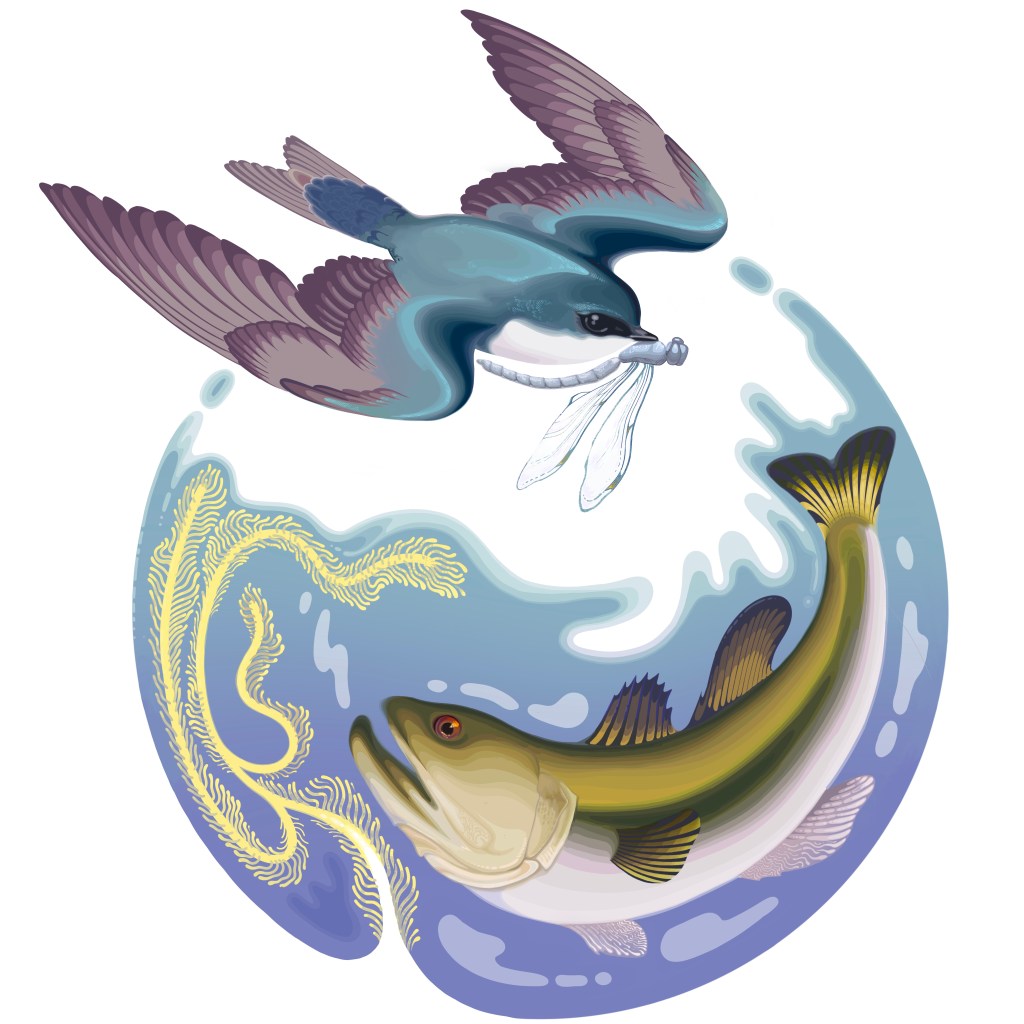
Cornell University Experimental Ponds Logo (2024)
While creating this piece, I was once again lucky enough to get to chat with stakeholders to determine which elements would result in the most representative logo. At the Cornell University Experimental Ponds (CUEP), multiple labs conduct ecological research at hundreds of square ponds arranged in a grid. I chatted with three labs to understand the scope of their research, resulting in a circular image that features individual lab foci while simultaneously expressing reciprocity between different systems.
During the creation of this logo, I had one of my all-time favorite realizations. Despite having worked with Tree Swallows in the field, it took dozens of hours of recreating their likeness with a digital pen before I finally recognized that their iridescent back feathers camouflage almost perfectly with the shimmering blue pond water which they spend all day soaring and darting over.
Migration Celebration Logo (2022)
I have a had habit of saying this about all my pieces, but… this is one of the most fulfilling and fun logos I have ever created. Every year, the Cornell Lab of Ornithology hosts Migration Celebration, which is like a huge family-friendly science party where scientists present accessible research blurbs, the museum of vertebrates opens their doors for tours, professionals teach workshops like photography and audio recording, and clubs present a range of paraphernalia from live raptors to shark skulls. It’s an energy-filled, optimistic day, where people of all ages and backgrounds congregate to celebrate a natural phenomenon. In 2022, it was decided that post-pandemic Migration Celebration was due for a stylistic overhaul. My amazing manager Chelsea brought me onto the project, and I chatted with event organizers to decide on a color scheme and theme for the logo. I selected species based on their coloration, charisma, recognizability, and migration exceptionality. I decided to keep birds super stylized, prioritizing joviality and momentum. Because I illustrated each bird separately, I learned how to use Adobe Illustrator to combine them into a single vector image. When I look back at this logo, I get a sense of overwhelming gratefulness that I was able to collaborate with such a passionate and kind group of people.
The logo was debuted at the 2022 Migration Celebration. At the actual event, I spent five hours doing face painting. I went into a total trance and the time flew by–I was shocked when I finally checked the time! I can only express gratitude to the many toddlers who were gracious enough to stoically endure my flow-state scrupulousness.
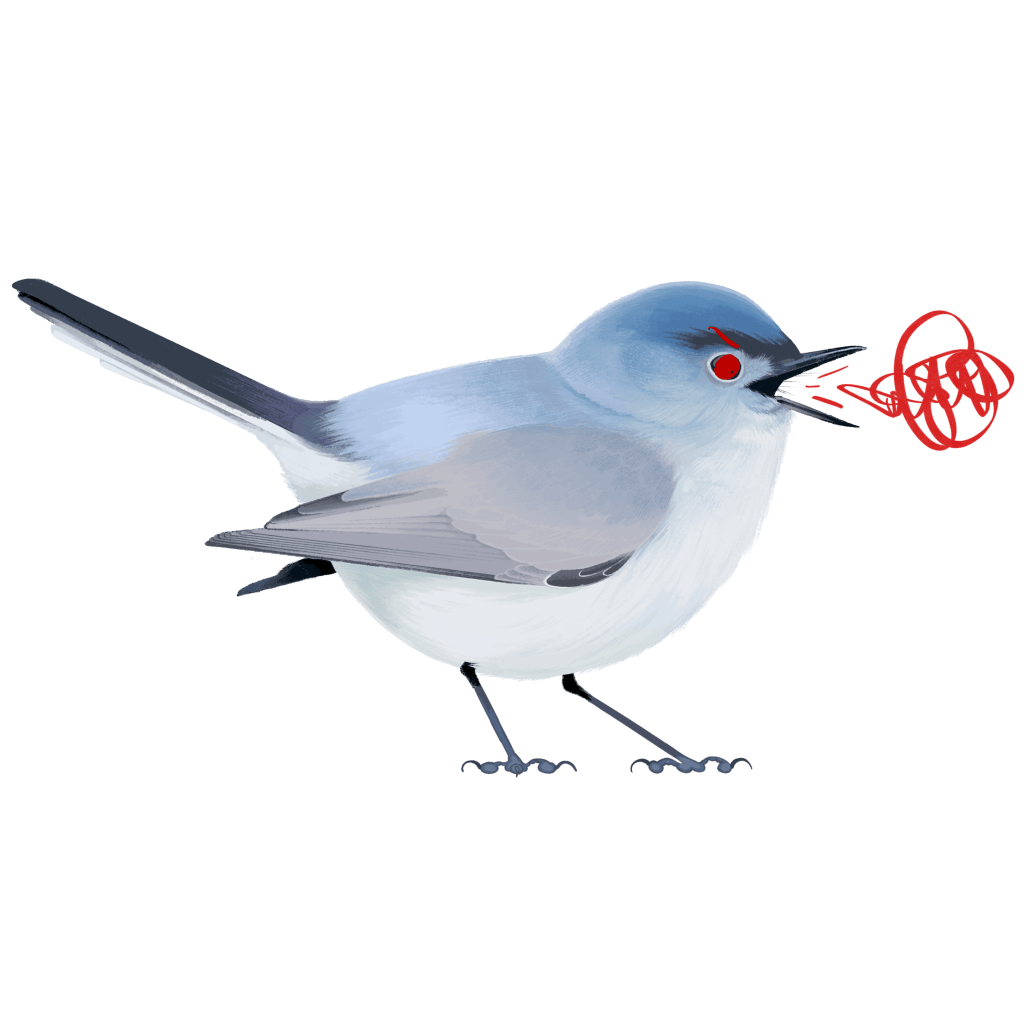
Blue-gray Gnatcatcher with a Lot to Say (2024)
During my time as a field tech in the Rattlesnake Mountains of New Mexico, I fell in love with these buzzy fellows and their bold black brow, which never fails to remind me of Oscar the Grouch.
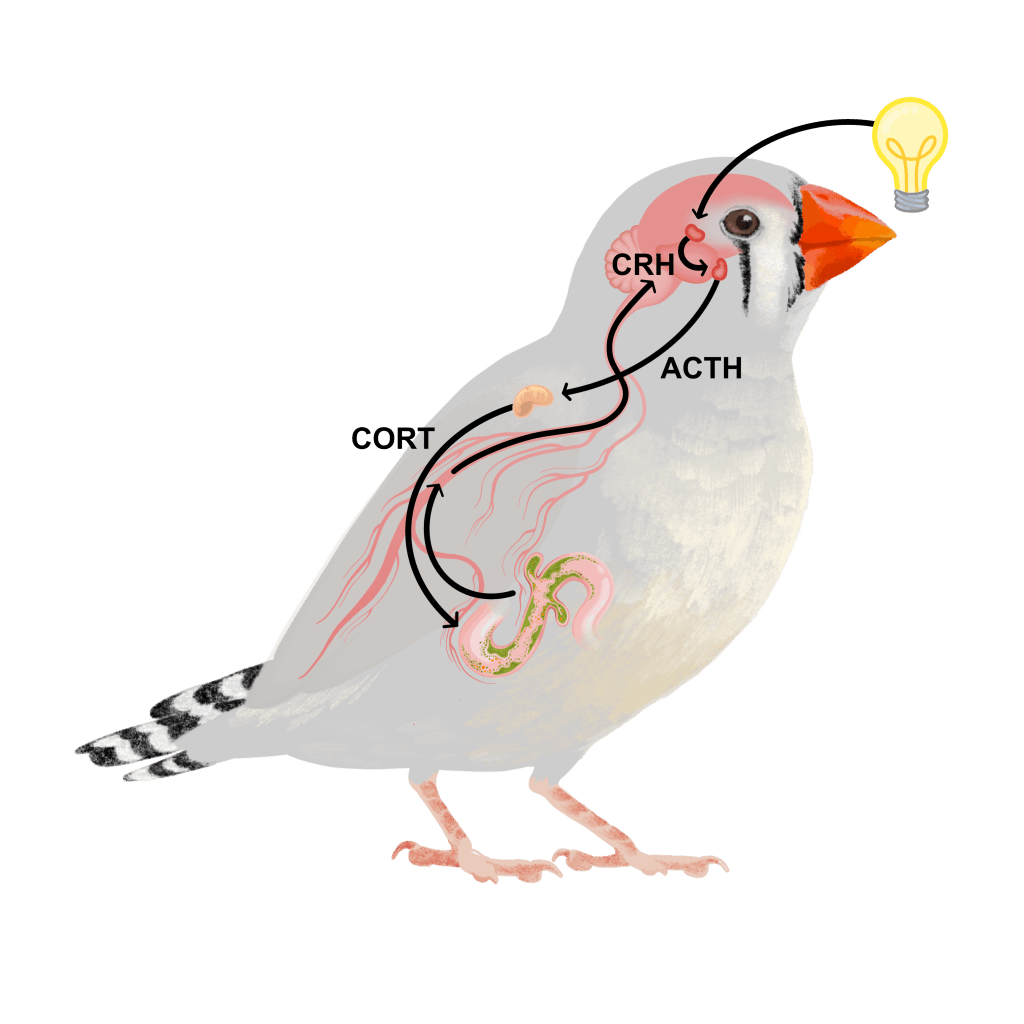
Zebra Finch Endocrinological Diagram (2025)
This figure, made in 2025 during my master’s program in Dr. Jenny Ouyang’s lab, expresses the hypothesized effect of Artificial Light At Night (ALAN) on the hypothalamic-pituitary-adrenal (HPA) axis and gut microbiome. This diagram contains minimal words and labels so that it can be used in an oral presentation without overwhelming listeners with extra words and clutter.
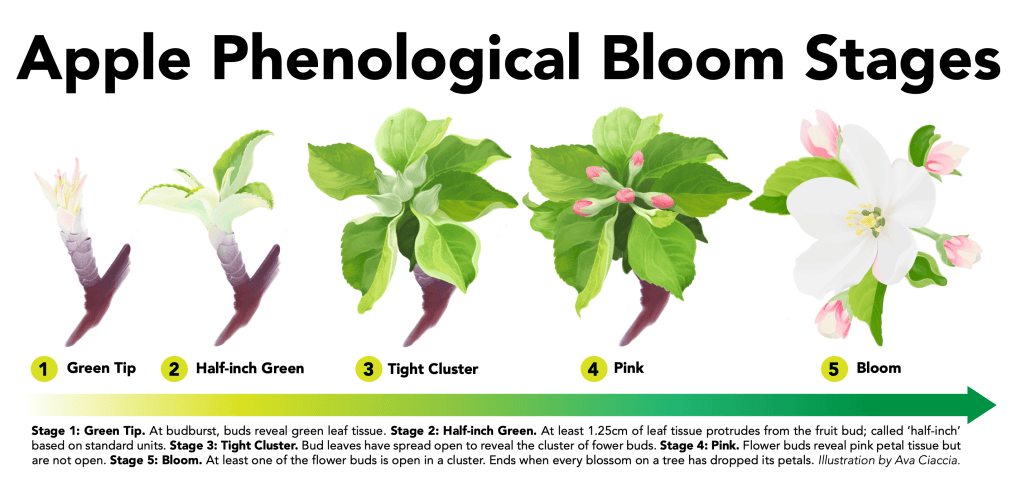
Apple Phenological Bloom Stages (2024)
This was a passion project created for a manuscript which never made it to publication. If you have a use for this, please email me! I would love for this piece to have some life, and am happy to provide you with a high-resolution image.
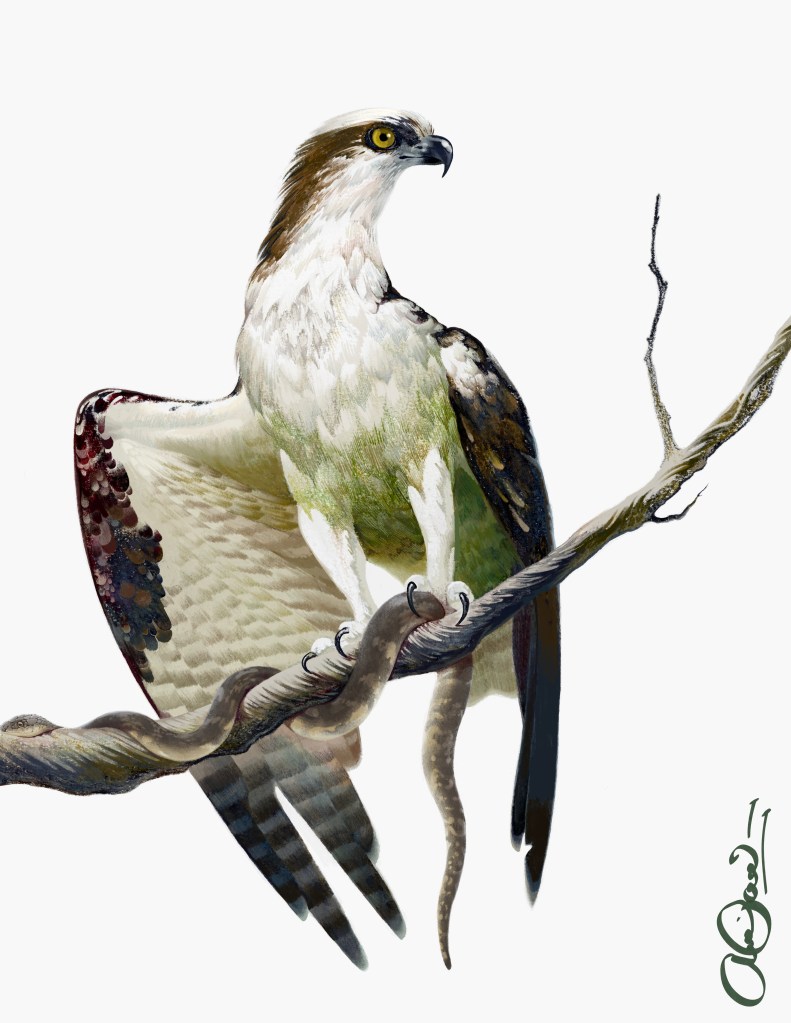
Osprey with Snake (2026)
Osprey are near and dear to my heart–not only are they a classic story of conversation success, they are the first species I ever studied in the field, back in 2021. Some may wonder why this “fish hawk” (as some call them) has a snake in its grasp. Although Osprey almost exclusively eat fish, they won’t turn down a convenient snake if the opportunity presents itself, and many anecdotal reports of snake-hunting exist.
Although shallow-diving Osprey have more water-resistant oils than deep divers such as cormorants, hunting birds still do get wet or waterlogged. Perched after a hunt, this individual splays or “droops” his wings out to dry them in the sun.
This piece began as a colored pencil sketch in 2023. Recently, I’ve been experimenting with scanning in old “analog” pieces and adding digital detail to my heart’s content. The finished piece is crisp, but its physical foundation leaves it with a pleasing amount of grit and complexity.
I don’t know if I would have become a scientist if it wasn’t for an excellent mentor taking me under her wing during my first field season. The lovely blog maintained by said mentor, On Osprey Time, is one of the internet’s great hidden gems.
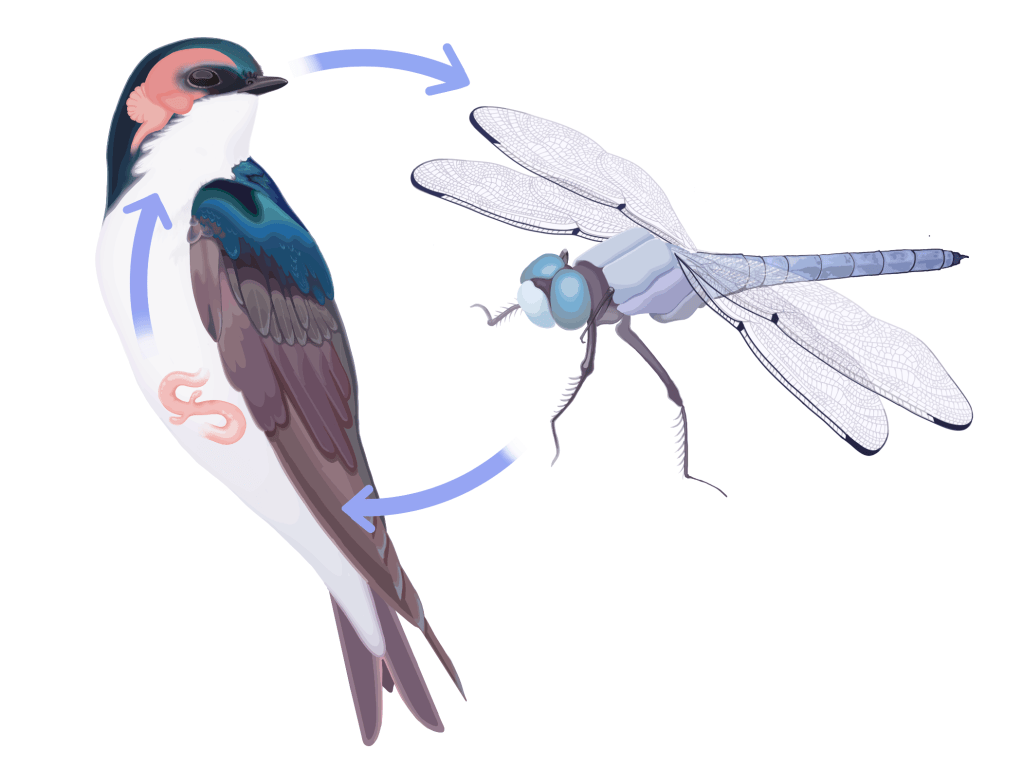
Tree Swallow Gut-Brain-Axis Minimalist Diagram (2023)
I designed this word-free diagram to help present the results of my undergraduate thesis. This diagram intends to express the reciprocal relationship between diet, gut microbiome, and brain physiology.
Looking back, I’ve learned a lot since then, and I see several things I could have done differently: the dragonfly, featuring not one bit in my research, should be a lot smaller here. The arrows are also confusing; the bottom one points to the Tree Swallow’s wing rather than its gut microbiome. Finally, the intestine doesn’t contain any visible bacteria, a big problem since the gut microbiome was the focus of my research!
I do appreciate undergrad me’s strict adherence to a color scheme. Although far from perfect, it does seem like the diagram did succeed in its goal: draw viewers to my poster so I had folks to chat with during my poster session.

